
How to Humanize AI Text Without Rewriting Everything
The fastest way to humanize AI text is not to add personality everywhere. Remove the parts that could belong to anyone, then put your actual point back in.
Start with the point you would say out loud
Before editing sentences, write one plain sentence that explains what you mean. AI-assisted drafts often circle a point with a broad introduction before arriving at it. Your first sentence does not need to sound impressive; it needs to give the reader a reason to continue.
Keep the concrete detail that makes the idea yours: the customer question, the awkward meeting, the exact constraint, or the decision you made. Specificity creates voice more reliably than extra adjectives.
Cut the polished habits
Look for throat-clearing such as "In today's fast-moving world", repeated transitions, and conclusions that merely restate the opening. These phrases are not always wrong, but they are often doing no work.
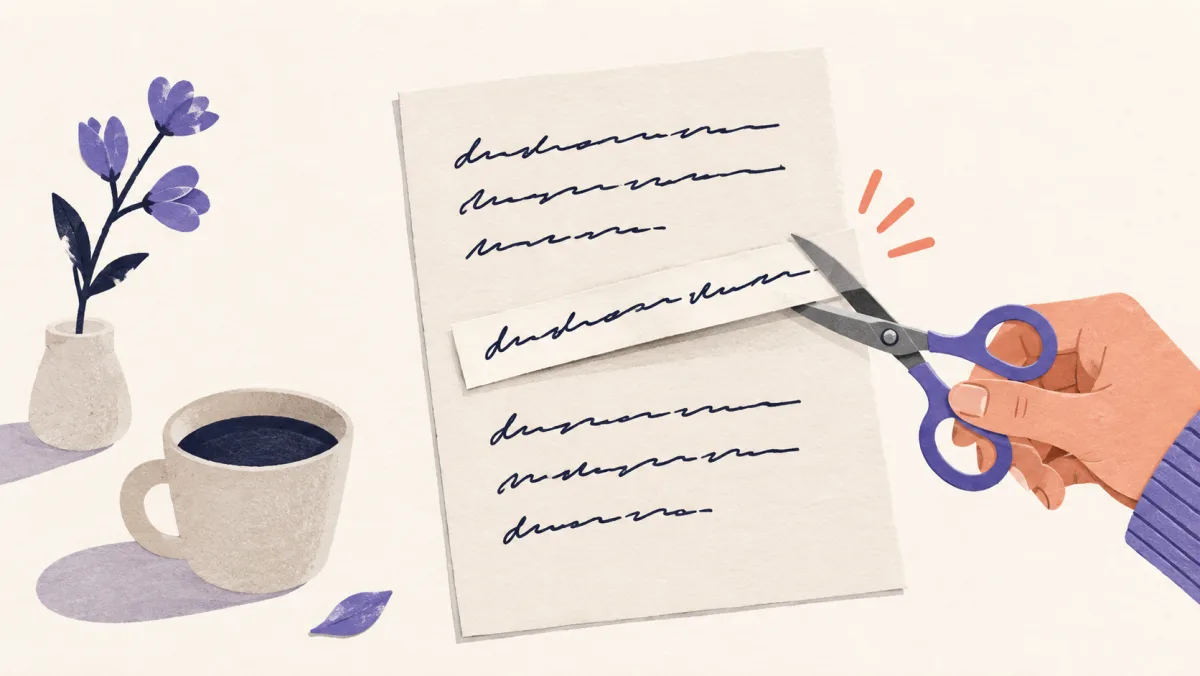
Try deleting a sentence rather than replacing it. If the paragraph still stands, the draft is already clearer. If it does not, replace it with an example or a useful qualification.
Change the rhythm, not the meaning
Human writing has movement. A short sentence can land after a longer explanation. A paragraph can begin with a question, a small disagreement, or a detail that makes the reader look twice. Read the draft aloud and mark places where every sentence has the same length and temperature.
Do not force slang or add mistakes. Natural writing is not careless writing; it is writing with a point of view.
Use a ten-minute edit
Read the draft once without changing anything. Write the point of each paragraph in the margin. If two paragraphs have the same point, keep the stronger one.
On the second pass, replace one broad sentence with one concrete detail. On the third pass, read only the opening and closing lines. They should tell the reader where the piece is going and what to do with it.
Keep the parts that carry your judgment
A clean draft does not need to sound neutral. Keep the sentence that explains why you chose one option, what surprised you, or where the plan may fail. Those decisions give the writing a person behind it.
Remove language that only announces importance. Explain the result instead. A plain observation is stronger than a grand claim with no evidence.
Use a final meaning check
After the style pass, compare the cleaned draft with the source. Check names, numbers, dates, claims, and the strength of every promise. A good cleaner should make a draft feel more like you without quietly changing what you meant.
Questions, answered
Frequently asked questions
Short answers to the questions readers ask before they edit and publish.
Can I make AI writing sound human without changing the meaning?
Yes. Separate the work into two passes: preserve facts and intent first, then edit repetition, filler, rhythm, and generic phrasing.
What is the biggest sign that AI writing feels generic?
A draft often feels generic when it uses broad claims and smooth transitions but contains few concrete details, decisions, or observations.
Should I add typos to make writing sound human?
No. Aim for clear, specific, purposeful writing. Authenticity comes from judgment and detail, not manufactured errors.
Ready to edit?
Keep the thought. Lose the drag.
Try Liltora on a draft, then make the final call with your own eyes.
Open the cleaner